
The funny thing about traveling is, that sometimes, maybe most of the time, it ends up that the destination is not what you remember, but more of the journey getting there. In the case of the Taj Mahal, looking back, I rememeber the long train ride, the taxi, the man getting shaved on the side of the road near a “public toilet”, the women carrying loads of grass on the top of their heads, the cow shit, the camel shit, the horse shit, the loads of people, and the woman who asked for some of our water once we got inside the Taj (which of course we simply gave her the whole bottle, I mean it is water, we all need it). The Taj itself, is indeed beautiful, but the brillant moments on our journey to get there are even more stunning.
Tag: India
-

Pushkar, India
Sometimes, when I look at the adventures I have been on, the countries I have seen, the landscapes I have walked through, the cultures I have gotten the chance to swirl in, I am simply baffled and cannot help but feel incredibly blessed. Pushkar is a small city in the Indian state of Rajasthan, near India’s border with Pakistan. In some cases, even the most devout of Hindus wait their entire lives to make a pilgrimage to Pushkar, for the fact that it holds one of India’s few temples dedicated to Bramah; yet, miraculously, Rob and I made it there. Of course, when people ask you about India, it seems to be that the terrible instances get highlighted. Most often because people ask, “well, isn’t it dirty?” or “didn’t you get sick?” or “weren’t you uncomfortable as a western woman?” I guess it is also because the wonders of India are so very hard to explain. How can I rightly explain what it is like to watch the sunset over the Holy Lake of Pushkar, a lake infamously created by the tears Sati when her beloved husband Shiva passed away. How can I spell out the echoing song of the holy men, the soft tender cries of elderly beggars, the chatter of gypsy children pleading for a simple chapati, the call of street traders selling their catchpenny items. It seems close to impossible. Also, deeply personal. Somewhere inside, I constantly think to myself, why am I trying to explain the wonderment of India; unless a person is to experience it for themselves, they are never going to truly understand. But, of course I will keep on trying, muffling that small thought every now and again. So, yes, Pushkar is a facinating city; one that was truly worth the trip. Though it is very small in comparison to even Udaipur, a day can easily be filled by walking through the shops, trying to find ways to get around without walking near the entrance of the lake (where Sadhus time and time again ask you to come to the lake for prayer, which costs you-the tourist- as always- a pretty penny), eating vegetarian delights that you had no clue existed, watching the sun set over the lake from the many lakeside rooftops, counting cows, playing cards and drinking chai. Okay, it may not sound so facinating here, but its in these simple acts that you encounter so many things. For example, we wanted to send some dresses home to our nieces, so of course, we went to the post office. Well, what would take fifteen minutes in our western fast world, took half the day in Pushkar. It was actually fun though. We got to go inside the post office, spoke to the local postman who painstakingly took our dresses, wrapped old cloth around them and sewed up the sides for packaging. He spoke of the travelers he has met in his many years living in Pushkar, all while searching through piles and piles for a pen that could actually write on cloth. He was genuine, real and a delight to chat with. There were so many times that a normal task turned into an “experience”. This of course happened everyday on our travels, but in Pushkar there was something in the air that made every encounter heavier, more gritty and forever memorable.
-

Udaipur, India
Udaipur, India, in the state of Rajasthan. An incredible beauty. From Ahmedabad, we took a RedBus to Udaipur, which was about a 6 hour bus ride. Something like that. Udaipur is more of what I had always imagined India to be, in so far as Architecture and such, with the palaces, small streets, vendors gallore, a dirty lazy river and ghats rolling between where people swam, bathed, gathered for prayer, did the wash and even drank from. We stayed a total of 4 days in Udaipur, all which were filled with new sounds, colors, dirt, warmth, cow poop, trash and happiness. Freedom. Up to this point, I had vehementently refused to rent a scooter while in India. For me, the roads in India are a dangerous place for a foreigner to drive. I mean, Indians clamour about in old caddy cars, horse trailers, tractors, bicycles, elephants, donkeys- not to mention the Holy Cows wandering through the roads- and all without clear rules and regulations. Indians know this to be true, so I promise, I am not slandering here. But, Udaipur is so big, so if we were going to see its true sights, it seemed I needed to give in on the whole “renting a scooter thing”. So I did. Some parts were scary as hell, but we did it. One of the most beautiful sights for me was the Monsoon Palace of Udaipur, formerly known as the Sajjan Garh Palace. The Monsoon Palace was our first destination outside of the city that we wanted to go see, and with our scooter, it was now all possible. The palace itself overlooks Lake Fateh Sagar. It was built in 1884 by Maharana Sajjan Singh of the Mewar Dynasty. The palace itself is not that incredible, but the views you can see from it ARE. It offers a panoramic view of Udaipur and the Aravalli Hills. And by traveling there, you will gain new white and black, long tailed friends- monkeys. I think Macaws.
-

Adalaj Stepwell, Ahmedabad, India
The sheer size of the Adalaj Stepwell in Ahmedabad is insane. Built in 1499 A.D. by Queen Rudabai, the Vav (step well) is several stories in depth and was intricately carved to meet its importance. It is a stunning piece of artwork. Upon our arrival to the step, we were a bit taken aback, as the outskirts of it is swarmed with people, indian style. There is a busy market next door, which is not for tourists really, but more for the small village the vav sits next to.
Before entering the vav, we made a stop at a beautifully maintained temple. Honestly, I am not sure which Hindu god it adorned, but it was vibrant and beautiful. After this short stop, we headed into the well; I found it stunning. Not only the history behind it (as the vav was used on ancient trade routes), but the design of it. I think the picture above captures what I can’t put into words. The designs on its walls and pillars include, leaves, flowers, birds, fish and other ornamental designs. Inside nooks and crannies, you can find both bats and people, both which have come to see this beautiful historical monument.
-

Calangute, Goa, India
The Indian State of Goa; formerly a Portugese colony, equipped with such past remininces mixed together with all the spice of today’s India. We stayed in the town of Calagunte, famous for its proximity to gold beaches, the Old Portugese Fort and chill hippy feel. We arrived in Calagunte via RedBUS, which took us a total of 20 hours from Bangalore. Upon our arrival, we searched for a cheap taxi to take us into town. After about 20 minutes of bargaining, we were off no better than we started at $8 for a 20 minute cab ride. We stayed in Calagunte for six days, mostly chilling around town, eating wonderful food and taking our mo-ped to all the beaches and small towns in the area, constantly getting caught in torential rain.
One day, I made an appointment at an Ayruvedic Clinic just outside of town. My appointment was from 11-12, so Rob came back to come pick me up at 12:00 sharp. On his ride to come in get me, the sky was clear, but literally 5 minutes into our ride home, nature starting spilling car-size droplets on our head. We could not see two feet in front of us, so we found a tree to which we thought would provide us with shelter until the rain lightened. But, the tree could not even help. There was nothing to do but laugh, dance in the rain and be so thankful for life. We waitied for around 25 minutes, just talking, shivering, dancing, and laughing (me doing most of that) and then the sun broke free of the rain’s chains and we quickly hopped back on the bike. Shortly after is when I snapped this picture above. I found it beautiful, just like Calagunte.
The sights of everyday life always brighten my soul and during our time in Calagunte, an “everyday” included Monsoon Season life. With fewer tourists around, life in Calagunte during Monsoon season is slow, lazy and free; women walking in fields after hard rains, men in bars at 10 am sipping on cold beers, couples plowing their field with their faithful ox, children running and splashing in flooded soccer fields. Simple and beautiful.
-
Bangalore, India
Just a short flight away from Colombo, lies the Silicon Valley city of India: Bangalore. Truly, we did not know what to expect, for the reason for traveling to Bangalore was more that we could hangout for a couple of days with my old roomate and her husband (Priyal and Jamshed). Therefore, Bangalore took us by surprise. It is s seriously cool city.
Formally known as Bengaluru, Banglore is the capital of the state Karnataka and is the third most populous city in India. Bangalore has a really comfortable climate, sitting at over 900 meters above sea level, and can therefore be enjoyed year-round. Out of all the cities we have visited thus far, we deemed Bangalore as the most livable. As a sprawling metropolis, every corner has something to offer, whether it is an old temple, a historic market, or a new modern cafe (such as The Smoke House or I and Monkey).
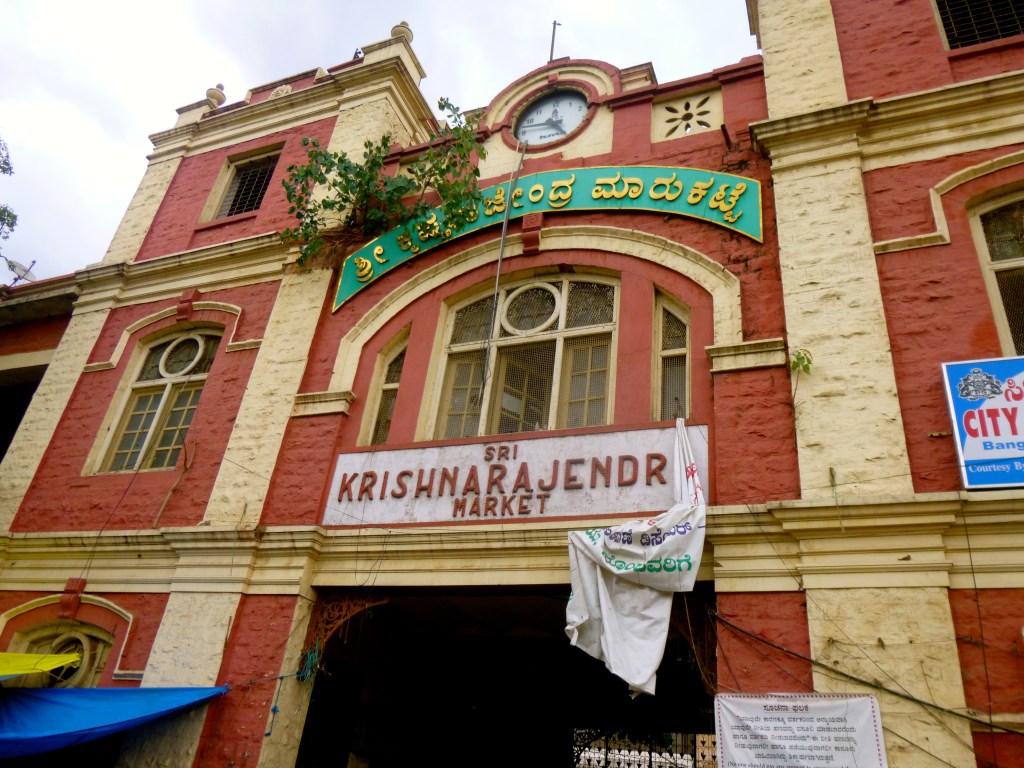
The photograph taken above is from the front of the Krishnarajendra Market, which really was a whole city in itself. Every walk of life meets here to get their goods: clothing, food, utensils, spices, toys- just about anything. And as most bazaars, upon entry, you feel as if you are walking back in time. Thinking to yourself, “wow. this is what a supermarket use to look like.” Furthermore, I am sure many Westerners would be set-aback by the hygienic state of the market, but that didn’t stop us. In fact, I think it spiked our curiosity even more. Walking between sacred cows and their poop, vegetables, clothes, sewage, monkeys, bare feet and piles of trash, our curiosity was rewarded by the new sights, sounds and smells. Our day was incredible, our stay was perfect and we hope to get back to Bangin in Bangalore some day in the future.:) Thanks again to our dear friends for letting us stay at their home: a home filled with a lot of love, beautiful people and ridiculously good food.
 Allison A Janssen