Tag: trekking

  • Sabah, Borneo, Magical Land, Dream World, any of these barely suffice.

    Sabah, Borneo, Magical Land, Dream World, any of these barely suffice.

    Ever since watching the Discovery Channel as a young child, I had dreamed of finding my way to Borneo. The Discovery Channel, constantly did episodes on Borneo’s impressive rainforests, which used to be highly protected from human impact. It’s rainforests are home to some of Nature’s most beautiful and elusive plants and animals, such as the Rafflesia flower, the Pygmy Elephant and the Bornean Sunbear. Borneo is also home to the Sepilok Orangutan Rehabilitation Center, which is a facility that provides medical care for orphaned and confiscated orangutans, as well as dozens of other wildlife species.

    It is an amazing region, filled with one of a kind wonder and beauty. And thanks to the Discovery Channel, I was determined to get there.

    Our first stop was in the capital city of Kota Kinabalu. While KK is the capital, it is more like a large village. But, there is still a good bit to do and see! Ever wonder where the first Survivor Episode was taped? Borneo. Yup, on the island of Pulau Tiga, just off the coast of KK. From KK, you can jump to most any island and go snorkeling, hiking and sight seeing. Both fortunately and unfortunately, all the islands are protected and you can therefore not spend overnight anywhere unless you are with a company doing a tour. Even then, I think the limit is two nights. But, KK itself, is a great place to rent a motorbike and simply tour around; there are a few good look out spaces just at the edge of the city line, if you are interested. During the first days of our arrival in KK, we spent most of the time on the back of the motorbike and in cafes, figuring out how to travel inland to both Sepilok and Sukau, to adventure through the wild and trek alongside the Kinabantagan River.

    Regardless of what people say, you can do this trip the backpacker way and catch buses and taxies to each destination. Just be prepared to feel a bit lost at times. The great thing is that East Malays are incredible friendly and truly want to help you get where you want to go! We took shared taxis and buses the whole time we were in Borneo, and everything worked out just fine.

    From KK, there are so many places in Sabah to explore. For us, I had planned this leg of the trip, so our first stop was therefore, of course, the Sepilok Orangutan Rehabilitation Center. To actually go into this refuge and watch 8 Orangutans swing into sight, eat, chill, sleep and pee was literally one of the most rewarding experiences for me on our trip. I was fulfilling a dream! These animals are so much like us humans it is unreal! And yes, you can say you saw one in a zoo… I promise, it is not the same thing.   The Orangutans at SORC have acres upon acres of wild jungle to explore. They are not in captivity. They actually only come in at feeding times. We heard that there are times that tourists come to see the great animals, and to their dismay, none of them show up for breakfast, finding their own food wherever in the sanctuary they may be! We were incredibly lucky to see eight of them, one being just a baby! Watching their large toes curl around bananas and lift them into their mouths whole, left me with my mouth wide open in a gasp. And when they stand up and walk, hug each other, turn their head side to side, take a nap, pretty much anything they do, they look like humans. Really, I could go on about our similarities forever. But, if i did that, I would never get to talk about trekking and long boating along the Kinabantagan river inside the Borneo Rainforest, one of the oldest rainforests in the world. What a life changing experience it was to watch King Fishers fly into their favorite spots, see anacondas slithering on banks, hear monkeys of all variations jumping and calling across tree lines, observe orangutans perched at tree tops, witness owls flying during daylight hours, feel crocodiles lurking under our boat, be annoyed by mosquitos slamming into us on all fronts, to duck from a bats’ flight, to have to survey every inch of our bodies for leeches as we returned to our rooms and to come lie in bed at the end of the night and think about our shared reality under the beauty of the 140 million year old Bornean Rainforest.

    It is no wonder that Borneo’s Rainforest has been scientifically traced as the center of the evolution and distribution of many endemic species of plants and animals. As a wanderer there, you literally feel like you are in the nucleus of the atom that is our world, feeling shock waves of energy, vibrancy, wholeness and oneness.

    So, call it what you want. Borneo, Sabah, East Malaysia… None of these express the beauty that this region holds. No words can hold the such a powerful vibration.

    All I can really say is, there could be no better last destination for our big 2014 trip. Every moment from May-September 2014, with just Rob and I, was beautiful, whole, meaningful, fulfilling, enlightening and faultless; and Borneo, you gave us the exact epic end we were needing.

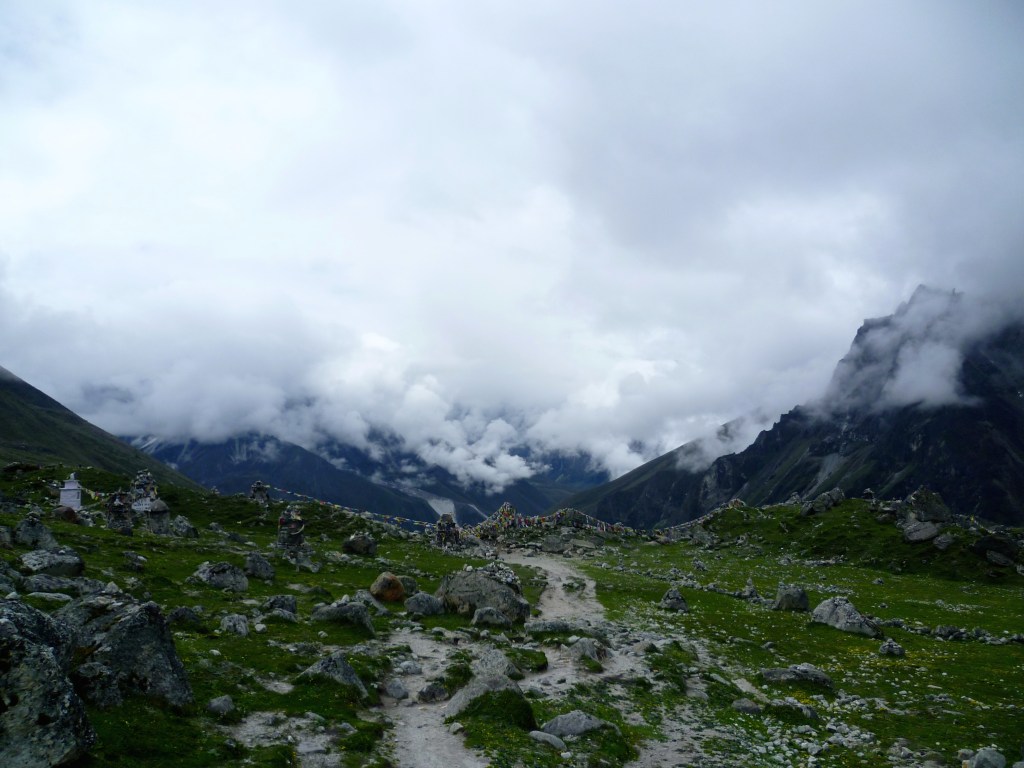
  • Day 9: Lobuche to Gorak Shep

    Day 9: Lobuche to Gorak Shep

    Out of all the tea houses we stayed in, I hate to say it, but I think the one in Lobuche was my least favorite. The set-up was just odd. There were about 8 or so rooms on one cement hall, interconnected by a cemented bathroom to another cement hall with its own 8 rooms. It was all pink dark cement. Odd. To add, everything was wet and dingy. It was off-season, we get it. Anyways, when 6:30 wake up call came, I was ready to throw on my clothes and hit the trail. Before doing the grudge work of getting out of my sleeping bag, and packing everything up, I took a peek out the window of our small room. I could see that the clouds wanted to take a gander at what the ground felt like. Heavy rain swells lied within them, and it was almost certain to me that our morning hike would be a wet one. Rob took a look as well. In agreement, we slid on an external rain tight layer that we bought for under 30 Euros in Kathmandu. Apparently Northface. In a jiffy, we were headed to the breakfast table for, who would have guessed it, porridge and oats. Sustenance is sustenance eh?

    Roughly around 7:30, we walked out into the wet cloth of outside and headed for Gorak Shep. The air was really wet a thick, yet a deep inhale still filled my entirety with fresh mountain air. So entirely invigorating. Within the first 100 meters, we saw a helicopter landing pad made of green grass and yellow flowers and painted rocks which made the H with the circle around it. Being that my Gramma is a helicopter pilot, I automatically thought, how cool would it be for her to fly here right now and see us climbing this trail! Everest, I am sure, is out of the question. My next thought was, I am glad we have not had to fly a helicopter this trip. A helicopter flight would have meant a life threatening situation and at least $5,000. So, yes, glad no helicopters joined our adventure.

    Gorak Shep lies at 5184m. It was about a 3 hour walk from our tea house in Lobuche. For some reason, I had envisioned that the last stretch to the last tea house would be tough. But, it could quite possibly have been the easiest day, both physically and mentally. The streak from Lobuche to Gorak Shep is just a steady, constant incline. No major changes. Just steadiness. The trail climbs over rivers, valleys and makeshift bridges, but all with rather easy forward footing. Once the rain came, my initial reaction was a bit of dread, but after a couple of minutes and the realization that my rain gear worked, I was so happy it was raining! With strong legs, steady breath and a light heart, we treaded on! Life felt real, gritty and beautiful. And as we mounted the village of Gorak Shep, just a short three hours after departure, a beautiful white horse stood under the day’s last view of Everest. All I could do was smile with my heart.

  • Day 8: Periche to Lobuche

    Day 8: Periche to Lobuche

    After a day and a half of rest and relaxation in the soft valley of Periche, we picked the trail head back up early morning on Day 8. According to estimations, Lobuche our next destination, would take us about 4-5 hours to get to, even though it was only 700m away. The reason for the lengthened time, lied solely in the fact that half of the trail that leads to Lobuche resembles the old Agro Clag from Nikolodeon’s game show GUTS, only it is longer. No kidding. The climb has to be at an 80% grade and took us at least an hour to climb. It was tough. But after the steep climb, a surreal moment awaited. A moment that took our mental breath away.

    At the top of the steep climb lies a small, shallow trough that overlooks the valley of Periche, previews the mist towards Louche and is home to the truthful Everest Memorial. I am not sure if it is official, but in this small glen lies the grave stones of all those who lost the epic battle against mother nature, the gravestones of those who lost the battle of Everest.

    From small piles to big piles of stone, lie the memories of courageous people. People from all over the world. People who had the same dream as many others, but were actually brave and determined enough to seek it, even if it meant their end.

    This was a truly captivating moment. A moment that was very hard to remove myself from. But, our destination was calling us onward. So, we rightly left behind the memory filled stones, keeping the recognition of their bravery with us and headed towards our own kismet.

  • Day 6: Tengbouche to Periche

    Day 6: Tengbouche to Periche

    A rooster? All the way up here? Really? Those were my first thoughts in the morning after a too short of night’s sleep in Tengbouche. Must have been the smell of paint that kept me awake. In any event, I rose out of bed with a smile; to the trail we go. But, first, breakfast. Funny enough, being halfway through our ascent, one of the biggest things I noticed outside of nature, was the teasingly long, but limited menu. During high-season, these trails have full-blown English breakfasts, pancakes, noodles, more Dal Bhat, eggs… everything. But, for us, there was only oatmeal and Dal Bhat; which, by this time was starting to get a bit old. Luckily, I had brought with us some dried fruits to add a little something to the monotony of oats and warm water. And when you spend all day hiking, nourishment is nourishment after all. So with a big swallow, Rob and I took in our oatmeal, drank cozy tea, filled our water bottles with our water/tang mixture and headed out for the 3-4 hour hike to Periche.

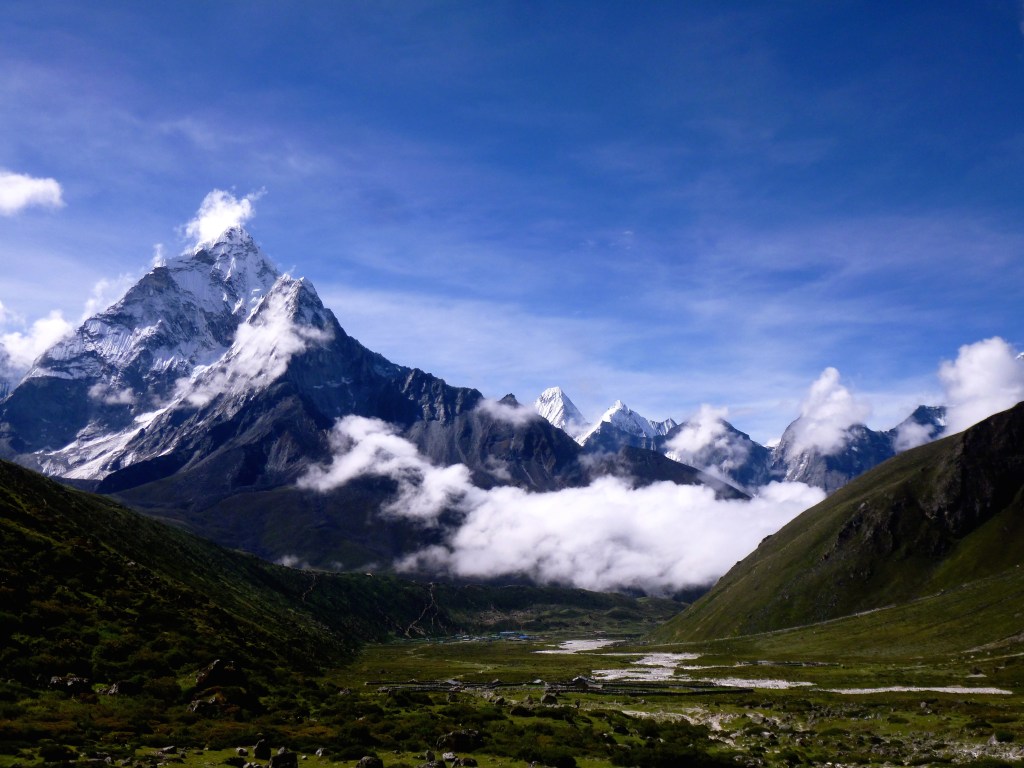
    This part of the hike was really interesting, because our destination- Periche- lies literally in the middle of nowhere. It is nowhere near the larger cities of Lukla (which connect to Kathmandu) nor is it close to the Himalayas notorious climbing peaks. Periche lies somewhere in the middle. To get there from Tengbouche, we began a most immediate descent, which eventually leveled off into a steady incline for a good couple of hours. An absolutely beautiful day was upon us. The sun was shining lightly on our backs, the roar of the Dudh Kosi river within reach, and displays of the beauty of the Himalayas all around us. At one point, we even saw a wild/stray horse perched underneath a view of Ama Dablam. He/she most likely used to be owned by someone, but we could tell from the protrusion of its ribs and wild hair, that it had been a while since a human cared for it. But, more so that it simply looked free, much in the way I imagined ourselves. Free.

    After around a total of 4 hours, we came upon a point where the Dudh Kosi river made a deep twisting bend, which required us to climb a bit higher to make the turn. Once we made the turn, I stood awestruck and agape at the beauty that lied ahead. Before us lied a valley of small flowers, rock homes and a babbling brook that shook hands with the Dudh Kosi, close to its twisting bend. Views from most all of the famous Himalayan peaks can be seen from the point of Periche; you simply just have to catch a moment in time where God opens up the cloudy gates and allows perfection to be seen.

    Being that it was still early in the afternoon upon our arrival, Rob and I made a point to check out the small village of Periche. To our delight, most everything was closed. Somehow, closure of all of the hotels, shops and so forth, had become a comfort. Somewhere along the line, the periodic closure of the few restaurants and hotels made our experience that much more real. More true. Like we were closer to nature because of it. So, we strolled around Periche, watching the quiet nature of the village unfold.

  • Day 5: Namche to Tengbouche

    Day 5: Namche to Tengbouche

    Perching at a height of 3,867 metres is the incredibly small villiage of Tengbouche (Thyangboche). Tengbouche holds great importance to trekkers, Buddhists and the people of the Himalayas, for it is not only a good place to rest your head, but also is the home to the largest gompa in the Khumbu region, the Tengbouche Monastery. Thinking back, I believe the Tengbouche Monastery is even mentioned in Peter Matthiessen’s 1978 book, The Snow Lepoard. Which, by the way trekkers, is a great book to read in preparation for your trekking adventures in Nepal. It helps you to begin thinking in “butterfly detail”, noticing every light flicker in the forest, the crunch of the rocks under your feet, the sturdy nature of the mountain- it simply helps you to conciously awaken your senses.

    In any event, Tengbouche is about a 5-6 hour hike from Namche. As soon as we left the villiage of Namche, roughly around 8 am, we began a rolling descent/ascent scheme. Rob and I kept saying, it seems so counter intuitive that we just hiked an pretty intense upward climb to get to Namche, only to descend the same distance a day later. But, we were too elated to be back on the trail to whine. After around an hour or so, we found ourselves much closer to the Dudh Kosi river. Then, at some point, Rakesh said that we would now begin the ascent to Tengbouche. He said it would take around 2 hours or so. Give or take. And so we began an endless amount of switch backs.

    I took only about 12 pounds with me in my pack. Mostly carrying water, snacks, extra socks, a small shovel, jackets, lighters, medicines and eco-friendly toilet paper. (Another thing trekkers, if you need to use the restroom, which you will, because you need to stay hydrated during your trek, the most environmentally sustainable way to use the restroom is to find a spot in the woods, dig a little hole, use the restroom, cover your tracks and then burn your toilet paper. True statement.) BUT 12 pounds on these switchbacks was not easy, I won’t lie about it. My shoulders were achy from the weight and my lower back was ill-thrilled from the hunching I was doing. I did bring Tiger Balm from India with me, which saved me during times like these. Just enough relief to get through it. After a seemingly infinte number of switchbacks, we walked through the gates to Tengbouche. Funny enough, after feeling the aches in my shoulders, it was ironic to see a man carrying up a full trunk of a tree on his shoulders, Nepali style, balanced by a head band and rope. I immediantly forgot about my shoulders. P1060443

    Wouldn’t you?

    After standing astounded, with my jaw wide open, Rakesh moved us onward towards our tea house for the night. Mostly all of them were actually closed, but one remained open for the few trekkers who would be on the trails during “off-season”. We were warmly welcomed with the smell of paint (they were also doing some remodeling) and a pot of tea. They asked us if we would like cold bucket shower… and we declined. Wipees would do with the cold temperatures outside. After getting a bit more settled in and ordering what we would like for dinner in the evening, Rob and I went to explore the Tengbouche Monastery. I had been really looking forward to seeing it in full swing, imagining the bells chiming, incense flowing, the harmony of the chanting monks and the sounds of dongs ringing loudly. But, to our disappointment, the monks had left to hold a gathering in a neighboring village and were not present; only a single monk and his two dogs were left to keep the Monastery afloat. Lucky for us, we were allowed inside to take a look around and read the stories on the walls. Escaping a bit into the simplicity of Monastic life. It was absolutly beautiful. Regardless of how empty it was, I could feel the life within the walls, the prayers and truths revealing themselves as I grazed the painted stories with my hands.

    After around thirty minutes inside, we were led out by the guarding monk, and returned back to the tea house for an evening of Dal Bhat, cards and tea.

    Life in the Himalayas is both simple and compounded. Once I released myself from the hectic nature of my mind’s creation, I found peace, and through this peace, my mind found that in the simple things, life is its most full. Like taking in a full breath of air, noticing how it tastes, smells, feels, reenergizes my body; imagining the rush of blood through my veins and the expansion created by the sip of oxygen. And the most wonderous part was to then open my eyes and see the panoramic views of the Himalayas, including the well-known peaks of Lhotse, Ama Dablam, Thamserku, Tawache, Nuptse and Everest.

    I am extremely thankful to be alive.

  • Day 3: Diamox and Namche

    Day 3: Diamox and Namche

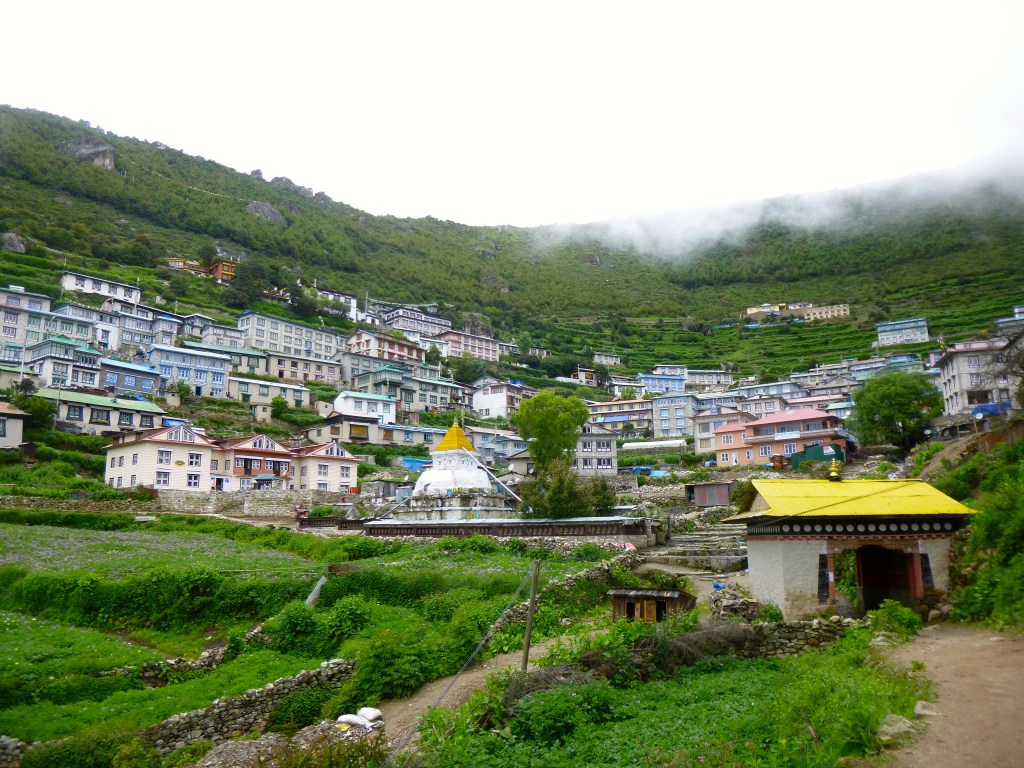
    We sauntered lightly over deep trails, trails slicked by mountain dew and sodden green moss; trails that without a doubt hundreds of thousands of villagers and Asian wayfarers have once treaded. In my day dreams, built by the tales of time’s trekkers, story tellers, Kathmandu villagers and today’s bloggers, Namche was a busy trading point, where people from across Asia met to trade a melange of goods. It was supposed to be the gathering point of Tibetan, Indian and Nepalese mountain villagers. A place where most any good could be bought or traded. I imagined it being crazily busy, hazy, similar to the scene set underneath the Boudhanath stupa in Kathmandu. To my surprise, and later delight, Namche was anything but hustling. It was quite quiet actually. Upon arrival, my eyes kept searching for what my imagination believed was the reality of Namche. But, almost every store seemed to be dark, shut, and unwelcoming to the wandering trekker. People were absent. Gone. Our previous destination of Phakding seemed more awake than this sleepy city. But of course, it is “off-season”.

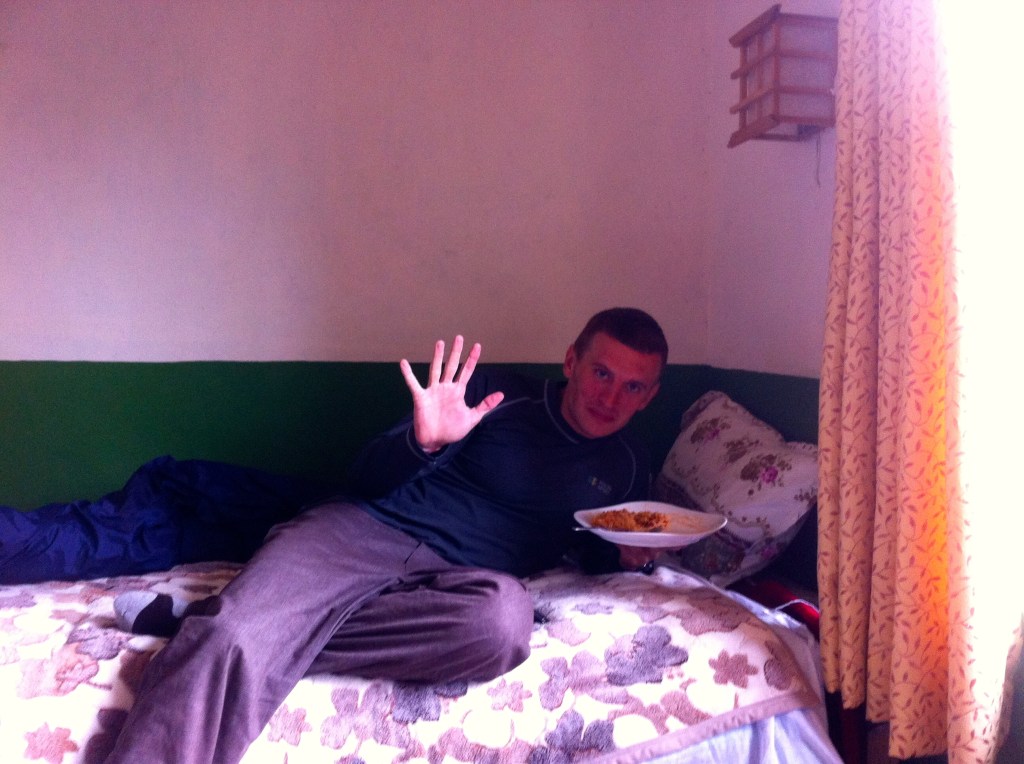
    After around a ten minute walk through the village, seeing only a few children playing in a wet field and one woman fetching water, Rakesh told us to unload our bags. Apparently, we had arrived to our hotel for the next two nights.  Expecting that the tea house owners would come out of the front door of the building our bags set on, I faced against the mountain’s view. Then, I suddenly heard a small, happy voice right behind me. As I turned around, I saw the cutest woman and another shy soul behind her. I am kicking myself for forgetting her name right now, but I remember her name didn’t seem fitting. I remember thinking, no, your name should be “Happy”. Her hello even held a giggle. After a few exchanges in Nepalese with Rakesh, she took us to a room on the bottom floor of the incredibly large building. It seemed strange because upstairs looked much nicer than the room she showed us to. Later, we would learn that being it was off-season, they were in the middle of some remodeling. Happy offered us the only room she felt suitable; two twin beds, a toilet, and enough rain water held in buckets to provide a shower if we wished and enough water to flush down what was necessary. Good is good, we said. So, we settled in, changing clothes, adding more layers on, and waiting for Rakesh to tell us the plans. And what were the plans? Basically, the game plan was to acclimatize. To spend the evening and the full next day getting use to the elevation we were at and the decreased oxygen levels. So, we spent the first evening playing cards, eating spaghetti (that was cooked in a temporary kitchen built for us), and reading. After, setting into our sleeping bags, we drifted off to a soft slumber together. While Rob slept like a bear in hibernation, I woke up in the middle of the night gasping for air.

    Literally, gasping.

    Fear rose inside of me, as I walked to the bathroom, looking for a light. Where is my “Rough Guide: Nepal”? I know they said something about this, I thought. I was panicking. I quickly shut the bathroom door behind me, so that the light would not wake my soundless husband. I sat on the toilet, flipped through my “Rough Guide: Nepal” book and tried to catch my breath. In through my nose, out through my mouth, I kept telling myself. Though this calmed me, I was still short of breath. Finally, I found the page on acclamating to the elevation differences throughout the Himalayas. Words like helicopter, throw-up, diarhreea, expensive, and death POPPED out to me on the page. But, somewhere inside, I was determined not to need DIAMOX. Though almost every former trekker whose blog I read had taken diamox to help them acclimate, I somehow thought I would be different; that my body would adjust to nature’s grip around me. But, as the night grew colder, and my gasps grew louder, I gave in. I took a half a Diamox and stuck out the rest of the night. By morning, I told Rob what happened to me in the middle of the night. He obviously did not have the same experience. But, since I was taking the Diamox now, he would too. Long story short, we acclimated to the elevation of Namche, and with Diamox floating in our systems, the uphill climb we faced in the coming days would be much more oxygenated. Thankfully.

    Lesson learned: Why try to beat the odds when the risk is high? Simply take the dang Diamox and get on with it.

    Lastly trekkers, don’t worry about purchasing diamox or any other medicines in advance. Get them all in Kathmandu. It is both cheaper and easier.

  • Day 2: Phakding to Namche

    Day 2: Phakding to Namche

    The day awaited us. I could feel my bones rise, sparks fire between the neurons in my brain, the hairs on my arms surge, my feet twitching – anticipating the moment they would get to slide into my hiking boots. I was beyond excited. I thought to myself, okay, what all should I wear? It feels quite cold, but today is supposed to be THE toughest part of the hike. So, on went my sports bra, a breathable T-shirt, khaki hiking shorts, my North Face rain jacket, wool socks and my North Face Boots. I swept my hair back, brushed my teeth, and quickly packed my bag, Rob’s bag and Saroj’s bag (for it was our extra stuff he was carrying). Once we were all packed up, we headed down stairs, just before 7:00 am. A full breakfast of oatmeal, tea and more tea, warmed us right up. So, with warm bellies, the four of us set off for Namche. Rakesh, our plugged in and knowledgeable guide from Good Karma Trekking, had warned us a bit ahead of time that Day 2 would be the toughest day. Namche Bazar sits at an elevation of 3,450m or 4,413 feet, which on average should take around 6 hours to get to from Phakding. Pretty much as soon as you walk out of the village of Phakding, you begin a slow ascent. Step by step, as the air got lighter, less dense- so did I. I FELT ALIVE. SO AWARE. SO CONNECTED. My blood pumping through my body, hearing the light thud of my heart, the rushing sounds of the Dudh Kosi River, feeling the cold sweat on my forehead and almost touching the songs of neighboring birds. LIFE WAS ALL AROUND US. WE were part of it. It was an incredible feeling. At around 11, we stopped to take a break and have some lunch. This was our second time to order off of an ‘off-season’ menu, which basically means that almost everything on the menu is not available. In actuality, you can get dumplings, dal baht or soup. We went for Dal Baht. And honestly trekkers, just go with Dal Baht almost every time you eat. You are guaranteed to be filled with enough nutrition to sustain you for the hours of climbing ahead, you most certainly will not get sick from it, and well, it tastes really good! Oh another thing, make sure you packed some kind of water aid. We packed TANG. It can change your normal Puni Pani (water) into something new, and tasty, for any other kind of refreshment on the mountain besides water and tea is expensive! Don’t forget it. You will want something to change the monotony of water on your taste buds. Now, where was I?

    After lunch, we got right back on the trail. We were quick on time, so Rakesh said we did not need to leave right away, but we were eager! So, we did anyways. From Phakding to Lukla, you cross the majority of the cable bridges that suspend high between mountain passes. Feeling our muscles beneath us, we climbed an incredibly long, mostly straight lined ascent. And as we entered through the holy passageway to Namche, slightly out of breath, we smiled from our heart to our lips.

  • Breathing for the second time: Lukla to Phakding

    Breathing for the second time: Lukla to Phakding

    If my first breath was a second after my birth, then my second true breath would have to be the moment we started walking towards our destination- Everest Base Camp. Day one, of eleven days of walking, wiggling my toes, groping trees, asking for Puni Pani, widening my eyes, smelling crisp evergreens, feeling small rocks slide beneath my feet, hearing – literally hearing the wind blow in twisting streams past my ears, and climbing to the steady pat of my heart had begun. I felt so completely alive. Conscious. Aware. Thrilled. And so eager. I could feel my heart smiling. After setting our bags on our backs, Rakesh and our lovely porter Saroj from Good Karma Trekking, led us through the “busy” streets of Lukla towards our next destination: Phakding. From Lukla to Phakding is only about a 3 hour walk; an easy “climb”. But, it seriously might as well have been 24 hours, in so far as in 3 hours, I experienced a days worth of imagery, beauty, enchantings. Within the first five hours, from flight to foot, the EBC trekker is already witnessing waterfalls, donkeys on trails, cows on trails, the refreshing effulgent Dudh Kosi River whipping rapidly through the Himalayan Valleys, and entrancing lower valley life. It is a bit funny, because there is a visible difference between lower valley folk and those in Kathmandu. It is almost tangible. Nothing better or anything, just different. You see this difference in the warmth of their smiles. The lack of city worry. But, beware trekkers: do not let your competitiveness think that you can walk faster than a small Nepali girl carrying fifty pounds of luggage. She might be chatting with her friend behind her, playing music from her small phone, wearing flip-flops and carrying a hell of a lot more weight than you, but, my friend, she is faster. Her feet know these steps like the back of her hand. Wherever she is going, she will most likely get there before you do. Funny enough, she doesn’t notice it. She is just being herself, within herself, completely bare of your path, your plans and your intentions. She will give you a shy smile and be on her way, most likely wishing you a small “go well” in her head. Don’t try to keep up with her, watch her, watch her go forward in lightness and imagine the home she is waiting to find. You may even see her again, for the trails of the Himalayas are forever intertwining with one another, letting some go and pushing others forward, yet always allowing any soul to sit still.

  • Everest Base Camp Trek: “First we fly to Lukla”

    Everest Base Camp Trek: “First we fly to Lukla”

    In hindsight, the first step of our epic EBC trek was probably the most unnerving. Let me first set the scene. While in India, and staying with friends in Ahmedabad, we were surprised to hear that at the age of 14, our friend Kahan, trekked to EBC with his father. While he mentioned some “really?” kinds of things, on the lines of sanitation, water, and intensity, what frightened us the most was what he said of the first step of the EBC trek- The flight to Lukla. Kahan basically stated that if we made it through the flight, the trek to EBC, for us, would be cake. Of course this alarmed us, so we asked why? He said, one: the planes are rickety old things, flying at incredible altitudes in all sorts of weather changes; two: the landing pad is on the side of a mountain and is truly 1,500ft long and only 60ft wide, with a runway that ends in a blank mountain wall and has an uphill gradient of 12 percent.
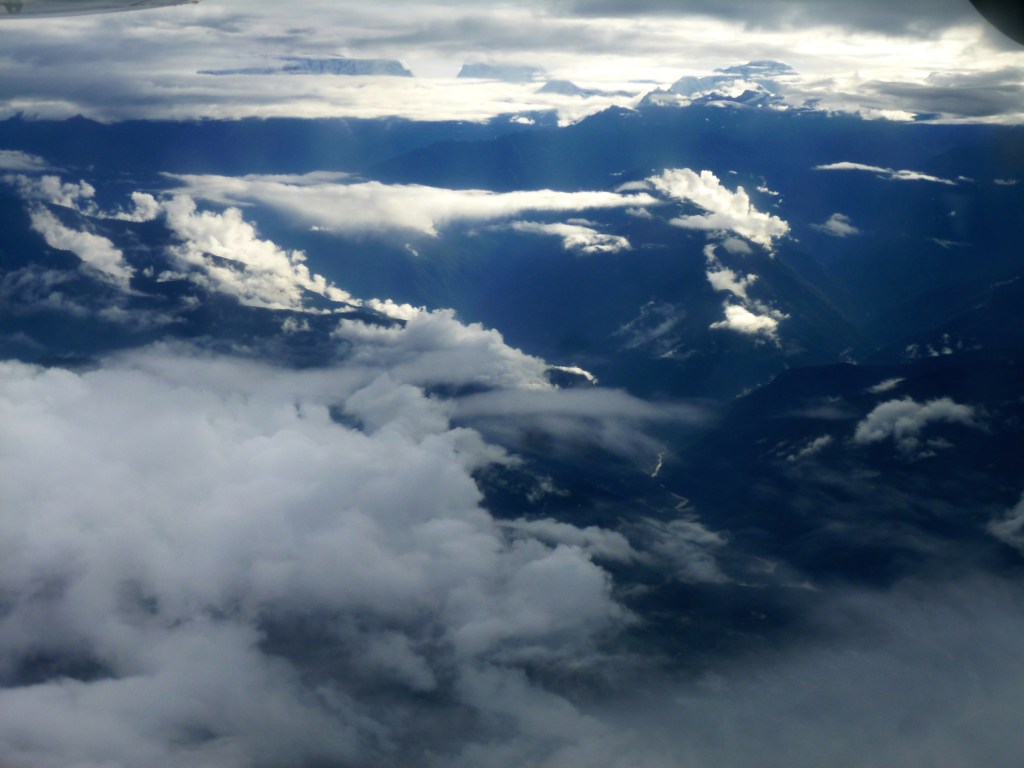
    HOLY COW. (Should I say holy cow in India? Oh well). And the story kept going, I promise. So, now let me tell you ours. After two days wandering around Kathmandu, drinking Everest Beer, preparing for our trek and seeing the sublime earthyness of Nepal’s capital, (which I of course will tell you about at a later date, because it is incredible), we were ready. So, on the morning of July 4th, 2014, we set out for our individual independence, our freedom and our couple and self-exploration. Wake up call was about 4 am, with Rakesh our amazing guide, picking us up at about 5am. Once we arrived at the airport, we could even see HIS nerves about flying. And he has literally made the flight hundreds of times- and still nervous? Now that is frightening. But, okay, I said a little prayer and boarded the 12 person plane. We were given candy to eat and cotton balls for our ears, and told to hold tight. Lift off was forcible and I was not armed. But, once we were in the air, the biggest smile came across my face. I kept telling myself, if we WERE to die on this flight, it was meant to be- so enjoy the beauty. As I looked back at Rakesh and the other Nepali passengers, I don’t think they had quite the same thoughts. But, as the picture shows above, I felt like I was the closest to God I had ever been at that moment. Outside the small plane, was a sea of mountains, light clouds with sunlight simmering through. The ectasy of the moment made me feel light, like cuddling in a bed of covers on a cold winter’s night. Part of this ecatasy was also knowing the next terrifying moment was ahead. So, when the captain said, “preapre for landing, I took a big breath and smiled back at Rob- “here we go”. The landing required so much percision. I mean, I get a bit nerved when a normal plane lands and then is taxiing towards the airport. This time, 1,500 ft away, there is nothing but mountain. You get me? But, we landed safely. And at that same split second, my journey of thankfulness and appreciation for my life and our beautiful world began.